
’Tis the Season for L’Aperitivo: Bringing Italy’s Favorite Ritual Home
’Tis the season for… le feste! As we are heading full speed into December, the holidays—and soon the new year—are fast-approaching. It’s usually a time of last-minute gift runs, school vacations, visits with friends and family, and a second look at our holiday dinner menu that we’ve nearly perfected three or four times already. In Italy, all of the above certainly applies, but often even more so. Children are off for nearly three weeks, and festivities run until January 6th, leaving plenty of time to soak in the holiday cheer. But when the stress creeps up and you’re looking for a moment (or an hour or two) to sit down and reconnect with loved ones or friends who are in town for one reason or another, Italians suggest one thing and one thing only: l’aperitivo.
The Italian concept of the aperitivo is nothing new—and to be clear, it’s not the same thing as the traditional happy hour. So let’s take a look at its origins.
The Apero Origins
Dating back to ancient Roman times, the early version of aperitivo involved small snacks washed down with a sweet wine. Fast-forward to the late 1700s, when the modern idea of aperitivo took shape in Turin (Torino). There, a local herbalist named Antonio Benedetto Carpano began experimenting with white wine infused with herbs, sugars, and spices. His creation, Vermouth, quickly became popular among Turin’s elite. This explains why northern Italian cities, from Venice and Turin to Milan, still have such an aperitivo-centric culture (but more on that later).
Though Vermouth paved the way for the modern 19th-century bitter craze, it really wasn’t until its ruby-red bitter friend, Campari, took the northern, specifically Milan, but storm. In 1860, Caspare Campari, following in Carpano’s footsteps in Novara, a small city west of Milan, created a super secret recipe of an infusion mix of herbs and plants that yielded an extra-bitter digestif (but not just any herbs and spices, but over 50 of them to yield what we know of Campari today. His son, Davide Campari, eventually followed in his father’s footsteps, taking the destination of the aperitivo ritual into his own hands by opening the Campari in Milan’s breathtaking Galleria. At this bar, Milanesi would socialize and drink a handful of cocktails with his famous Campari.
What about Aperol, you may ask? It was invented around the same time as the opening of Campari’s famous bar, by brothers Luigi and Silvio Barbieri, who hailed from Padova, creating a bitter that was lighter and lower in alcohol than Campari after seven years of experimentation. By the time the early 20th century rolled around, the cultural concept of aperitivo had been ingrained heavily into Italian life, especially once the Venetians invented what may be the synopsis for aperitivo: the spritz—coming onto the lagoon scenes post WWI.
From the cobblestones of Italy to your own cozy corners
After that little history lesson and background on Italy’s most beloved past time, those of us who have experienced it firsthand and others who only dream about it, no fret! There’s no need to take an international flight to get your afternoon dose of Italy’s favorite pastime. There’s no better way to wine and dine your guests than with a little Italian-inspired aperitivo at home. It’s easy, yummy, and not to mention, a great way to spend quality time with loved ones in the comfort of your home when the holiday stress gets to you. So, what do you need? Let’s take a look below.
The snacks
Shouldn’t the drinks come first? Well, it wouldn’t be an aperitivo without snacks, so let’s start here. After all, Italy is food-centric. The ideal snack tray for a killer apero, ones that are nearly served with every cocktail across Italy come 5 pm, the baseline trifecta is: a salty potato chip (never rippled), a beautiful glass bowl of bigger than life green olives, followed by even saltier peanuts…yes, embrace the salt attack come aperitivo hour!
To take things up a notch, especially at home, a cheese and sliced cured cold cuts is always an excellent option. Think: chunks of Parmigiano Reggiano and thin slices of spicy salami or prosciutto. There’s also extra points for a dish of tarralli if you can get your hands on them, Puglia’s ring-shaped extra soft yet a bit brunchy cracker, or slices of focaccia. The snack options are endless, but start with some basics that complement the drinks. Reminder: the food at a typical Italian aperitivo is not meant to be a complete meal, as one would see at dinner.
The drinks
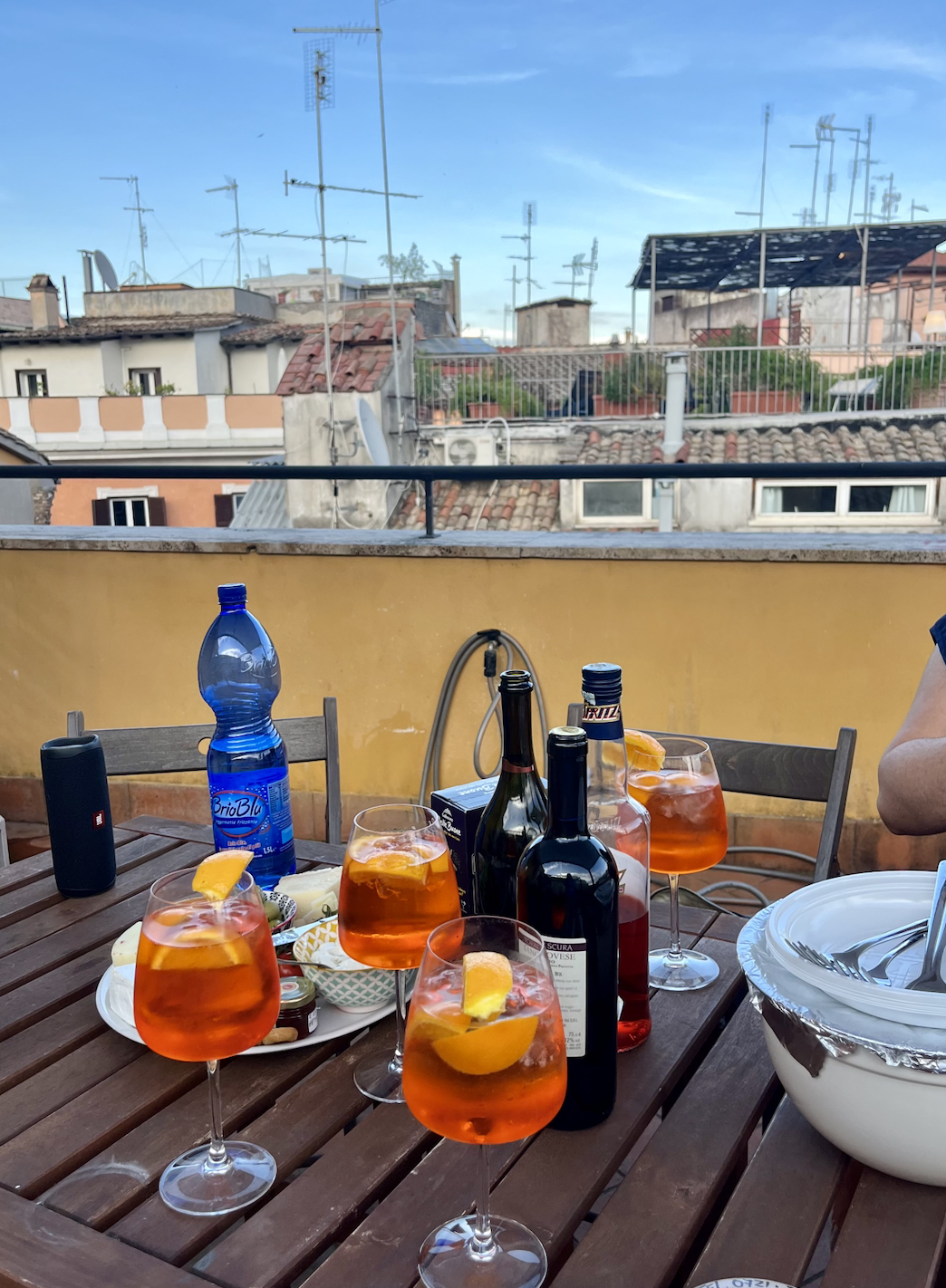
There is no right or wrong answer for what drinks should or shouldn’t be included at aperitivo hour, though, of course, variations of spritzes from Campari to Hugo and Aperol, a Negroni, and a gin and tonic do pop up regularly, along with an Americano. If you’re feeling a light glass of prosecco or white wine, these choices are excellent, too! Dead set on a Spritz? It is a classic, after all. Get the recipe right, which usually goes along the lines of: 1 part Aperol or Campari; 1 part prosecco; a splash of soda water; and perfectly sliced orange wedges for garnish along the rim. A Negroni, you make ask? Equal parts gin, sweet vermouth, and bitter Campari.
The presentation & ambiance
Have you got your drinks and snack menu ready, but something is lacking in the ambience? Even though the at-home aperitivo will never technically be like the one in Italy, it can certainly feel like it! How to set the mood? Start with a fun tablecloth that can immediately add charm, color, and a conversation piece. Use those ceramic dishes you’ve tucked away, or the oversized wine glasses and vintage cups inherited from a grandmother that have been stored in the china cabinet for “special occasions” only. If you were to ask an Italian, they would say that everyday life is a special occasion!
Little details like these elevate the moment and create an atmosphere that feels effortlessly upscale and delightfully Italian. String lights are the perfect moody booster if you’re outside, or if you’re inside, a few candles. Last but not least, some music: this playlist on Spotify absolutely sets the aperitivo mood with the most beloved Italian classics.